
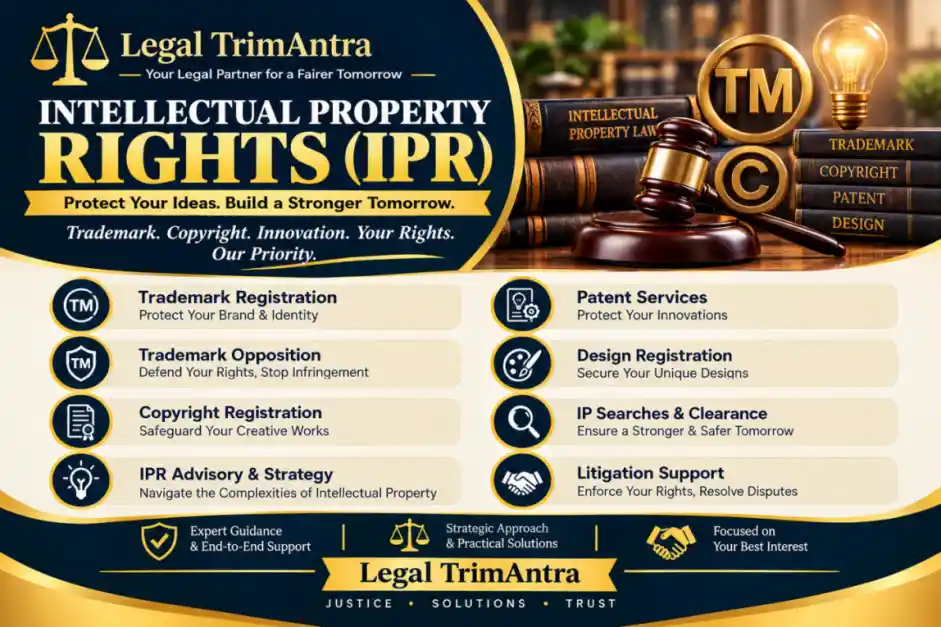
Intellectual Property Rights (IPR) – Trademark and Copyright
Trademark and Copyright Legal Services in Delhi NCR and Across India
A brand name, logo, photograph, website,
book, design or original piece of content can represent years of hard work. For
a business, it may be the identity customers recognise. For an artist, writer,
photographer or content creator, it may be the result of considerable time,
creativity and investment. Protecting these assets is important, especially
when someone else starts using them without permission or a dispute arises over
ownership.
Intellectual Property Rights (IPR) provide
legal protection for different forms of intellectual and creative work.
However, the protection available depends on the nature of the asset. A
trademark protects a brand's identity in relation to particular goods or
services, while copyright protects original creative expression, such as
literary works, photographs, music, films and artwork.
At Legal Trimantra, we provide legal
assistance in trademark, copyright and related intellectual property matters.
We assist business owners, startups, entrepreneurs, professionals, artists and
individuals with understanding their rights, preparing relevant documents,
addressing objections and taking appropriate steps when their intellectual
property is misused.
Our focus is on explaining the legal process
in clear language and helping clients understand the options available under
Indian law.
Our Intellectual Property Legal Services
1. Trademark Registration
A trademark helps customers distinguish one
business's goods or services from those of another. It may be a brand name,
logo, word, symbol, slogan or another mark capable of distinguishing the
relevant goods or services.
Registering a trademark can help establish
legally recognised rights in a brand and provide a basis for taking action
against certain unauthorised uses. Before applying, it is important to consider
whether the proposed mark is distinctive and whether similar marks already
exist.
Legal Trimantra assists with the trademark
registration process, including reviewing the proposed mark, identifying
relevant documents, considering potential conflicts and guiding applicants
through the applicable procedure.
2. Trademark Search and Selection of the Right Class
Choosing a name for a new business is
exciting, but discovering that another business already uses a similar mark can
create complications. A trademark search before filing may help identify
potential conflicts and reduce the risk of avoidable objections.
Trademark applications in India are filed
under the relevant classes of goods and services. There are 45 classes, and the
appropriate class or classes depend on the nature of the business and the
products or services involved.
We assist clients in reviewing their proposed
brand names and understanding the importance of selecting appropriate classes.
A search cannot guarantee registration, but it can help identify issues that
may need attention before an application is filed.
3. Trademark Application Filing
The trademark registration process involves
more than submitting a name or logo. The application must contain the required
details, identify the relevant goods or services and meet the applicable legal
requirements.
Depending on the circumstances, supporting
information may include the applicant's details, representation of the mark,
relevant class information and details of use, where claimed.
We assist with preparing the required
information and documentation for trademark applications and explain the stages
involved in the process, from filing through examination and possible
registration.
4. Trademark Objections and Examination Reports
A trademark application may receive an
examination report raising objections. These objections may relate to
similarities with existing marks, lack of distinctiveness, the description of
goods or services, or other legal requirements.
Receiving an objection does not necessarily
mean that the application will be rejected. The response depends on the grounds
raised, the nature of the mark and the supporting facts.
Legal Trimantra assists with reviewing
trademark examination reports and preparing appropriate responses based on the
circumstances. Depending on the case, this may involve explaining why the mark
is distinctive, addressing cited marks or submitting relevant supporting
documents.
5. Trademark Opposition and Related Proceedings
After a trademark application is advertised
or published in the Trade Marks Journal, another party may oppose it within the
prescribed period. An opposition may arise because of an existing brand, an
alleged likelihood of confusion or other grounds recognised under trademark
law.
Similarly, a business may need to oppose an
application that it believes conflicts with its existing rights.
We assist clients in understanding the
grounds of opposition, reviewing relevant records and preparing the necessary
documents for opposition and related proceedings. The available response will
depend on the evidence, applicable deadlines and circumstances of the dispute.
6. Trademark Renewal and Protection of Brand Rights
Trademark registration in India is generally
valid for ten years and may be renewed for further periods of ten years in
accordance with the law.
Businesses should keep track of renewal
deadlines and maintain appropriate records relating to their trademarks.
Changes in ownership, business structure or other relevant details may also
require attention.
We assist with understanding trademark
renewal requirements and related documentation so that clients can take the
necessary steps to maintain their registered rights.
7. Trademark Infringement and Unauthorised Brand Use
Discovering that another person or business
is using your brand name, logo or a confusingly similar mark can affect
customer trust and business reputation. In some cases, it may also lead to lost
sales or confusion in the market.
Trademark infringement and related
passing-off disputes require careful examination of the marks, the goods or
services involved, the circumstances of use and the rights claimed by each
party.
Legal Trimantra assists clients in reviewing
suspected misuse of trademarks, examining available evidence and understanding
the legal remedies that may be available. Depending on the case, appropriate
steps may include sending a legal notice, seeking an injunction or initiating
other legal proceedings.
8. Copyright Protection
Copyright protects original creative
expression in works recognised by law. It may apply to literary works,
articles, books, photographs, paintings, illustrations, music, sound
recordings, films, software and other eligible works.
For example, an original photograph taken by
a photographer, an article written by an author or an illustration created by a
designer may qualify for copyright protection, subject to the applicable legal
requirements.
Copyright generally protects the expression
of an idea rather than the idea itself. It does not ordinarily give someone
exclusive ownership over a general concept, fact, method or theme merely
because they thought of it first.
We assist creators, businesses and
individuals in understanding copyright ownership, the scope of protection and
the legal options available when their original work is used without proper
authorisation.
9. Copyright Registration in India
Many people assume that copyright protection
begins only after registration. Under Indian law, copyright generally arises
automatically when an eligible original work is created and the legal
requirements are satisfied. Registration is not compulsory for copyright to
exist.
However, registration may be useful as an
official record of the work and the details submitted with the application. It
can also be relevant when questions about ownership or authorship arise.
Legal Trimantra assists with understanding
the copyright registration process, identifying relevant information and
preparing the necessary documentation. The suitability and value of
registration depend on the type of work and the circumstances.
10. Copyright Infringement and Unauthorised Use of Creative Work
Copyright concerns can arise when
photographs, articles, videos, artwork, music, website content or other
protected material is copied, published, distributed or otherwise used without
the necessary permission.
For example, a business may discover that
another website has copied its original content, or a photographer may find
that their photographs are being used commercially without authorisation.
Before deciding on a legal response, it is
important to establish the relevant facts, identify the rights involved and
preserve evidence of the alleged use.
We assist clients in reviewing
copyright-related disputes, understanding the available remedies and
considering appropriate steps under the law. Depending on the circumstances,
these may include seeking removal of the material, sending a legal notice, negotiating
a resolution or pursuing legal proceedings.
11. Legal Notices for Trademark and Copyright Disputes
A legal notice may be appropriate when
another party is using a trademark or copyrighted work without permission, or
when a dispute arises over ownership or authorised use.
A notice should clearly explain the relevant
facts, identify the rights being asserted and state the action being requested.
The appropriate wording depends on the circumstances and the legal basis of the
claim.
Legal Trimantra assists with preparing
intellectual property-related legal notices and reviewing responses where
required. Before taking action, we consider the available documents, evidence
of ownership or use and the nature of the alleged infringement.
12. Licensing, Assignment and Intellectual Property Agreements
Intellectual property may have commercial
value beyond its direct use by the owner. Businesses may permit others to use a
trademark, creators may license their work, and owners may transfer certain
intellectual property rights through an assignment.
These arrangements should clearly record the
rights being granted or transferred, the permitted purpose, payment terms,
duration, territorial scope and other relevant conditions.
We assist with drafting and reviewing
intellectual property-related agreements, including licensing arrangements,
assignment documents, permissions and relevant contractual clauses. The terms
should reflect the parties' intentions and comply with applicable law.
13. Intellectual Property Protection for Startups and Businesses
For a new business, choosing and protecting a
brand name early can help avoid difficulties as the business grows. Existing
businesses may also need to review their trademark portfolio, ownership
records, website content, marketing material and agreements with third parties.
We help startups, entrepreneurs and
established businesses understand the legal considerations involved in
protecting their brand identity and creative assets.
The appropriate steps will depend on the
business model, the nature of the intellectual property, the existing
registrations and the way the assets are being used.
Understanding the Difference Between Trademark and Copyright
Although both are forms of intellectual
property protection, trademarks and copyrights serve different purposes.
Trademark: A trademark helps identify and distinguish the goods or
services of one business from those of others. It is commonly used to protect
brand names, logos and other distinctive marks in relation to specified goods
or services.
Copyright: Copyright protects eligible original creative
expression, including literary works, photographs, music, films, artwork and
other qualifying works.
For example, a business may seek trademark
protection for its brand name and logo while also relying on copyright
protection for original photographs, website text, graphics or promotional
videos.
The same business may therefore need more
than one form of intellectual property protection. The right approach depends
on what needs to be protected and how it is used.
What Should You Do If Someone Copies Your Brand or Content?
If you believe that someone is using your
trademark or creative work without permission, it is worth addressing the issue
carefully rather than reacting immediately.
The first step is to preserve relevant
evidence. Depending on the matter, this may include screenshots, website links,
dated copies of the material, original files, invoices, registration records
and communications with the other party.
Next, it is important to understand what
rights you hold and whether the other party's conduct may violate those rights.
Not every similarity or unauthorised use will necessarily amount to
infringement, and the legal position depends on the facts.
A legal review can help you consider whether
a notice, negotiation, platform complaint or court proceeding may be
appropriate. The choice of remedy should take account of the evidence, urgency,
potential costs and applicable law.
Why Intellectual Property Protection Matters
Your brand and creative work may be among the
most valuable assets you build. A recognisable name can help customers identify
your business, while original creative work may support your professional
reputation or generate income.
Taking appropriate steps to protect these
assets can help establish ownership, clarify the terms on which others may use
them and provide a basis for addressing disputes.
Intellectual property protection does not
eliminate every risk, and registration alone does not resolve every possible
dispute. Maintaining proper records, using suitable agreements and seeking
timely legal guidance can nevertheless make it easier to understand and enforce
your rights.
How Legal Trimantra Can Help
Every intellectual property matter is
different. A new trademark application requires a different approach from an
infringement dispute, just as copyright registration differs from a
disagreement over ownership or licensing.
At Legal Trimantra, we begin by understanding
your requirements and reviewing the relevant facts and documents. We then
explain the legal position in straightforward language and discuss the options
that may be suitable for your situation.
Whether you are launching a new brand,
seeking to protect original creative work, responding to a trademark objection
or dealing with suspected infringement, our aim is to help you understand the
process and make informed decisions.
Intellectual Property Legal Services in Delhi
NCR and Across India
Legal Trimantra provides legal assistance in
trademark, copyright and related intellectual property matters across Delhi NCR
and other parts of India, subject to the nature of the matter, applicable
jurisdiction and professional requirements.
The process and available remedies may vary
depending on the type of intellectual property, the rights involved and the
relevant statutory provisions.
Frequently Asked Questions
1. Is trademark registration compulsory in
India?
Trademark registration is not compulsory to
begin using a brand name. However, registration can provide important legal
benefits and stronger statutory rights in relation to the registered mark and
specified goods or services. The protection available to an unregistered mark
depends on the circumstances and applicable law.
2. How long does a trademark registration
last?
A trademark registration in India is
generally valid for ten years and can be renewed for successive ten-year
periods, subject to the applicable requirements.
3. Can I register my business name and logo
as a trademark?
A business name or logo may be eligible for
trademark registration if it satisfies the applicable legal requirements.
Depending on the circumstances, separate applications for a word mark and a
logo may be worth considering.
4. Is copyright registration necessary to
protect my work?
No. Copyright generally arises automatically
when an eligible original work is created and the legal requirements are met.
Registration is not compulsory, although it may be useful as an official
record.
5. What should I do if someone copies my
website content or photographs?
Preserve evidence of the original work and
the suspected copying. The next step is to review ownership, permissions and
the circumstances of use to determine whether copyright infringement may have
occurred. Depending on the facts, a legal notice, request for removal or other
legal remedy may be appropriate.
6. Can I take action if another business uses
a name similar to mine?
Possibly. The legal position depends on
factors such as your rights in the name, the similarity between the marks, the
goods or services involved and the likelihood of confusion. A review of the
relevant facts and records can help determine the available options.
7. What documents may be required for
trademark or copyright work?
The documents depend on the service required.
They may include applicant details, the proposed trademark or original work,
evidence of use, existing registration details, ownership records, agreements
and supporting evidence. Additional documents may be needed for objections or
disputes.
8. Does trademark or copyright registration
guarantee protection against every dispute?
No. Registration can provide important legal
rights, but disputes may still arise over ownership, prior use, infringement,
validity or the scope of protection. Each matter must be assessed according to
the facts and applicable law.
Contact Legal Trimantra
If you want to register a trademark,
understand copyright protection, respond to a trademark objection or take
action regarding the unauthorised use of your brand or creative work, contact
Legal Trimantra to discuss your requirements.
We can help you understand the relevant legal
process, the documents that may be needed and the options available for your
particular matter.
Disclaimer: This page is intended for general information and does not constitute legal advice. Intellectual property rights, registration requirements and available remedies depend on the facts and applicable law. No particular outcome is guaranteed. Contacting Legal Trimantra does not, by itself, establish an advocate-client relationship.